PQC Code Signing in a CNSA 2.0 World: Preparing for the Quantum Leap
Published: September 9, 2025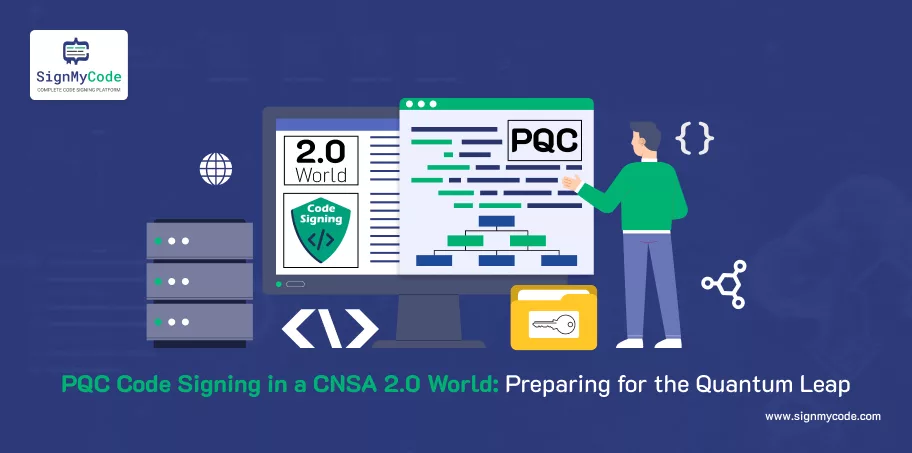
In 5-7 years, quantum computers will likely crack RSA and other currently used encryption methods. That’s not fear-mongering. That’s math.
Your enterprise code signing certificates? The ones protecting your software distributions right now? They’re sitting ducks. Every single RSA-2048 and ECDSA certificate you own will be worthless the moment a sufficiently powerful quantum computer comes online.
Most enterprises have zero post-quantum cryptography strategy. They’re flying blind into the biggest security disruption since the internet went mainstream.
Think I’m being dramatic? Ask yourself this. What happens to your business when customers can’t trust your software signatures? When malware gets distributed with valid-looking certificates because the underlying crypto got cracked?
This isn’t some distant sci-fi scenario. IBM’s quantum roadmap puts us at 4,000+ qubit systems by 2025. Google’s Willow chip just demonstrated error correction breakthroughs that bring cryptographically relevant quantum computers years closer than expected.
Large technology corporations are already in a rush. Apple began upgrading post-quantum cryptography to its iMessage system. Quantum-resistant protocols were introduced by Signal.
Most businesses, however, are content to use the same RSA keys they implemented five years ago. The companies that get ready will outlast. This post will provide you with a 90-day roadmap for quantum-proofing your code signing by the end of it.
Quiet Problem We Don’t Talk About
Most people assume cryptography protects from cyber attacks. It’s one of those invisible parts of the world that seems permanent, like concrete or electricity. You don’t wonder if it works. You just build on top of it.
Also Read: What is a Software Bill of Material? SBOM and Supply Chain Security
But cryptography isn’t concrete. It’s brittle. The strength of every algorithm we use today rests on assumptions about what’s hard to compute. And assumptions have a bad habit of expiring. When quantum computers finally cross the threshold, the cryptography we trust won’t erode. It will collapse.
We’ve lived for decades in a world where the math was comfortably on our side. RSA and ECC felt eternal because no one could imagine factoring a 2048-bit key or solving discrete logs at scale. But the history of computing is mostly the history of “impossible” problems suddenly becoming easy.
Why Code Signing Matters More Than You Think?
Most people never think about code signing. That’s the point, it’s invisible. But invisibility doesn’t mean unimportant. Code signing is how machines decide who to trust.
Every time your laptop installs an update or your phone pulls down a new app, it’s asking a simple question. Did this really come from who it claims to? The answer comes not from you, but from a digital signature.
Without that signature, software updates would be indistinguishable from poison. Malware could dress itself up as Chrome or Zoom, or Windows, and your computer would have no way of knowing the difference. Trust would collapse, not because the software got worse, but because the rules for proving authenticity disappeared.
Recommended: Top 10 Code Signing Tools for Developers
Code signing is so effective in use that we tend to forget about it. This is why it is fragile. In a quantum world, signatures of RSA and ECC will be easily forged. It will not require anybody to be a genius or insider, and all it will require is the raw power of new machines to process problems once considered impossible.
Suddenly, the silent background mechanism that determines what is safe to run will begin saying yes to everyone.
When individuals think of quantum risk, they visualise compromised encryption. The more alarming one is lost trust. In the event of code signing failure, it is not only secrets that leak. It is the entire software supply chain that is turned against us.
CNSA 2.0: The Map for Survival
When the ground starts to crack, the first thing you want is a map. CNSA 2.0 is that map. It’s the government’s way of saying, here are the algorithms you can still trust, and here are the ones you need to bury.
CNSA stands for Commercial National Security Algorithm Suite. It’s less of a mouthful than it sounds. Think of it as the official playbook for which cryptography gets to live through the quantum shift.
The first version gave us a set of classical algorithms, RSA, ECC, and SHA, that became the backbone of secure systems. CNSA 2.0 is different. It doesn’t just pick winners, it announces funerals. It tells you which old algorithms have to go, and which post-quantum ones to start using.
This matters because cryptography isn’t something you can swap at the last minute. Changing algorithms means changing standards, libraries, hardware, and in some cases, entire trust infrastructures. It’s the sort of job that takes years, not months. That’s why CNSA 2.0 exists now, before the trapdoor opens.
What makes CNSA 2.0 interesting is that it isn’t theory. Its policy is solidified into mandates. If you work in defence or government contracting, you don’t get to debate whether to adopt it, you’re told.
But even outside those worlds, it’s a preview. It’s a way of seeing what the future will require, written down early so no one has an excuse for being surprised.
Algorithms Behind CNSA 2.0
One of the most important things CNSA 2.0 does is draw a clear line. These are the algorithms that survive the quantum transition. Everything else gets left behind.
ML-DSA, formerly known as Dilithium
This is the new workhorse for digital signatures. It’s not as sleek as RSA signatures are measured in kilobytes, not bytes, but that’s the price of survival. If RSA was the elegant archer, ML-DSA is the armoured tank. Heavier, bulkier, but still standing when the arrows bounce off.
Recommended: AWS KMS Embraces the Quantum Era with ML-DSA Digital Signature Support
ML-KEM, once called Kyber
This one isn’t for code signing directly, but it’s just as critical. It handles key exchange, the part where two machines agree on secrets before they trust each other. Every signing infrastructure needs that scaffolding, and ML-KEM is the way forward.
LMS and XMSS, the Hash-based Signature Schemes
The third group is older, but still in the kit. They’re already standardised and available, and they resist quantum attacks by design.
The catch is that they’re stateful: each key can only be used so many times before it’s spent. That makes them reliable but fussy. They’re the kind of tools you keep around for firmware signing or tightly controlled signing, where you can manage state without slipping.
Notice what’s not on the list. SPHINCS+, also called SLH-DSA, is often mentioned because NIST approved it, but CNSA 2.0 doesn’t. It’s the paranoid option, with giant signatures and belt-and-suspenders security, but it didn’t make the NSA’s cut.
Recommended: Google Cloud KMS Introduces Quantum-Safe Digital Signatures Align with NIST’s PQC Standards
Hard Part: Code Signing with PQC
It would be nice if post-quantum algorithms were just stronger versions of the ones we already use. Like trading in a lock for the same lock with a thicker shackle. But that’s not how this works. PQC isn’t a drop-in replacement. It’s a new animal entirely.
The problem that arises about size is the first one. Signatures that fit into a couple of hundred bytes now run to kilobytes. That does not sound like a disaster until you realise that there are a lot of signatures generated and verified within a modern software pipeline.
Multiply that addition of the kilobytes by millions of updates, and all of a sudden, the overhead is no longer imaginary.
The second issue is speediness. Verification is slower, not orders of magnitude, but given every deployment, every device, and every handshake that is slowed, it adds up. Billions of silent checks are made every day in the world, and PQC adds an extra weight to all such checks.
And then there’s the ecosystem. Everything that touches code signing compilers, build systems, package managers, and operating systems has to learn how to handle these new algorithms. That means rewriting toolchains, upgrading libraries, and sometimes even changing hardware. You don’t just flip a switch. You rebuild the foundation.
And then there’s the ecosystem. Everything that touches code signing compilers, build systems, package managers, and operating systems has to learn how to handle these new algorithms. That means rewriting toolchains, upgrading libraries, and sometimes even changing hardware. You don’t just flip a switch. You rebuild the foundation.
Practical Steps to Transition
The mistake people make is thinking the quantum transition is like a software update. You pick a date, push a button, and you’re done. It’s not. It’s more like rewiring a building while people are still working inside. You have to plan it, phase it, and live with the mess for a while. The transition isn’t a single event. It’s a process.
And the earlier you start, the less painful it will be:
Identify Vulnerable Systems:
The first step is simply to figure out where you’re actually using cryptography. Most companies don’t know. It’s in firmware, it’s in internal APIs, it’s in update servers. Start with the high-value assets. Firmware updates, authentication systems, critical apps. Those are the things an attacker would go for first.
Recommended: What are Vulnerable Software Components? Common Attacks, Identify and Mitigate
Build in Flexibility:
Think in terms of crypto-agility. If your systems are glued to one algorithm, you’re already behind. Design everything so algorithms can be swapped out without breaking the whole machine. Use standards and protocols that support hybrid or multiple algorithms.
Start Testing Now:
Don’t wait for a crisis. Take some non-production code and sign it with LMS, XMSS, or ML-DSA. See what happens. Watch for the performance hits. See where the tooling breaks. You’ll discover problems now that would have been disasters later.
Partner with Vendors:
Your infrastructure is bigger than you think. Your HSM vendor, your PKI provider, and your supply chain all need to be on the same page. Many vendors are already building PQC support. Make sure your timeline matches theirs, or you’ll be stuck waiting while attackers aren’t.
Recommended: NIST Supply Chain Security Guidance for CI/CD Environments
Manage Keys Carefully:
PQC isn’t just new math; it’s new habits. Algorithms like LMS and XMSS are stateful, and they reuse a key state, and you blow the whole scheme. Use HSMs or TPMs to enforce discipline. Humans are bad at remembering rules. Hardware isn’t.
Recommended: Top Best Practices for Storing X.509 Private Keys
Plan for Hybrid Signatures:
The migration won’t be clean. For a while, you’ll be living in the messy middle, using dual signatures (classical + PQC). That’s fine, better than a brittle cutoff. But set target deadlines for when you’ll drop classical signatures. Otherwise, “temporary” will last forever.
Stay Informed and Compliant:
This is one of those fields where the ground shifts every year. Keep up with NIST updates, standards bodies, and regulators. Even if the math holds up, you’ll still need to show that you’ve kept pace with compliance.
Benefits of Getting Ahead
The firms that start now will already have crypto-agility baked in. They’ll have tested the algorithms, shaken out the bugs, and trained their engineers on how to work with keys that don’t fit neatly into existing systems. They won’t be trying to rebuild their supply chains under pressure. They’ll just be upgrading them.
The other advantage is trust. Customers, regulators, and even competitors pay attention when you go beyond the curve. In a world where software supply chain attacks are on the front page, that you can say self-serve integrated PQC and tested ones using hybrid signatures, is not just marketing. It is a moat.
Conclusion
The real risk with post-quantum isn’t being wrong about the math. It’s being late. Companies that move early turn chaos into an advantage, while those who wait will be buried in last-minute patches and rushed migrations. The cost of being late is always higher than the cost of being early.
If you want to get ahead now, before the scramble starts, contact us to Buy a Code Signing Certificate and start building trust in your software today.

Buy Code Signing Certificate
Increase your Software Downloads and Verify its Integrity by Digitally Sign Software and Executables using Trusted Code Signing Certs.
Price Starts at $215.99 Per Year