Zero Trust in DevSecOps Pipelines: Securing CI/CD Pipelines
Last Modified: November 4, 2025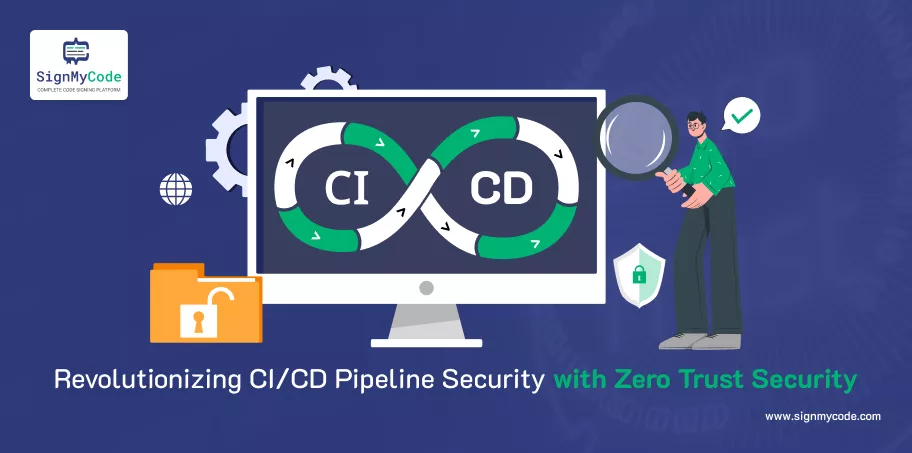
Your CI/CD pipeline may also be the rocket that propels your business, but it can also be the silent killer that will blow up all that you have created.
Think about it. You have automated code builds, testing, and deployments. Your people are driving features at light speed. Customers are happy. Revenue is growing. But beneath the surface? A single crack will cause the entire system.
A recent report states that over the past two years, supply chain attacks and CI/CD pipeline attacks have increased by over 600 per cent. Why? Pipelines are treated as a trusted environment. Hackers do not simply steal source code. Once inside, they steal it. They introduce malicious updates, steal credentials, and propagate malware to all the downstream customers.
All it takes is one leaked developer SSH key, one compromised build server, or one misconfigured pipeline step, and your “speed advantage” turns into a full-blown security nightmare.
Key Challenges in Securing CI/CD Pipelines
Your CI/CD pipeline wasn’t designed with security in mind. It was built for speed, automation, and efficiency. But the problem is that the attackers love shortcuts just as much as developers do. And your pipeline is giving them plenty.
Secrets Stored in Plain Text
Yes, it still happens. Hardcoded API keys, credentials in YAML files, or tokens tucked inside GitHub repos. For attackers, this is like finding a master key taped under your doormat.
Excessive Trust between Dev Tools
CI/CD tools are often chained together with minimal restrictions. Jenkins trusts Git, Git trusts Docker, Docker trusts Kubernetes. If one link gets compromised, the whole chain collapses.
Recommended: What is a Code Repository? Types, Best Practices and Tools for Repository Security
Lack of Visibility and Monitoring
Most teams don’t even know what’s happening inside their pipelines. Who accessed what? Which commit pulled in that dependency? Without logs and monitoring, it’s like flying a plane blindfolded at 30,000 feet.
You can correlate your CI/CD pipeline with this. Your pipeline is like letting delivery drivers walk straight into your office without checking IDs. They might be dropping off packages… or planting bombs. And unless you’re watching closely, you won’t know until it’s too late.
These aren’t “small issues.” They’re open invitations to attackers. And if you don’t lock them down, you’re practically rolling out a red carpet for the next breach.
Recommended: CI/CD for Mobile Apps Streamlining Development Efficiency
Understanding Zero Trust in DevSecOps Pipelines
The best way to understand Zero Trust is to strip away the buzzwords. At its core, it’s simple. “Never trust, always verify.” Every user, every tool, every commit, every deployment. If something touches your pipeline, you check it. Not once, but every time.
Recommended: AWS Lambda GitHub Actions Integration: Streamlining Serverless CI/CD
This sounds paranoid, but that’s the point. Old systems were built on the assumption that once you got inside, you were safe. If your code repo was “inside the firewall,” you treated it as good. If your Jenkins server sat on the company’s network, you assumed only the right people could reach it.
That model of trust worked well when you had everything within an internal network, but as soon as you start extending your pipeline to GitHub, cloud providers, open-source libraries, and CI/CD runners, the assumption falls apart. Attackers do not have to deconstruct your walls, as long as they can simply creep in masquerading as one of your tools.
Recommended: OWASP Top 10 CI/CD Security Risks: How to Mitigate
The DevSecOps culture consists of pushing security into each process. Zero Trust suits this best. It’s not an afterthought. It does not wait till deployment.
It authenticates identities during build running, authenticates signatures during dependency pulling, and scans artefacts during promotion. It makes the process of verifying a muscle-meme, such as writing tests or running git status.
The contrast couldn’t be clearer:
Old model → “You’re inside, so you must be safe.”
Zero Trust model → “Prove you’re safe, every single time.”
This isn’t about slowing down your pipeline. It’s about making sure your speed doesn’t come at the cost of security. Because in today’s world, trust is the biggest vulnerability you can have.
Recommended: NIST Supply Chain Security Guidance for CI/CD Environments
Zero Trust Security Principles in DevSecOps
The mistake most teams make is treating Zero Trust like a product you buy. It’s not. It’s a way of working. You take the assumptions you’ve always had that users are who they say they are, that systems behave as expected, that once someone is inside, they belong there, and you throw them out. What’s left is a culture built on proving things, not assuming them.
When you apply this mindset to a DevSecOps pipeline, a few principles stand out. They’re not theoretical. They’re practical rules you can test against real pipelines.
Least Privilege
Stop handing out all-access service accounts like free samples at Costco. If Jenkins only needs access to build, it shouldn’t have access to deploy. The less power you give, the less damage anyone can do.
Identity-first Access
No more “if you have the password, you’re in.” Every user, every service, every tool must prove who they are every single time. MFA, SSO, per-commit verification. If your intern can access production with just one password, you’re already in trouble.
Recommended: Microsoft to Enforce Mandatory MFA for Azure and Microsoft 365 Admin Accounts
Micro-segmentation
Hackers love lateral movement. It’s how one tiny breach turns into a full-blown disaster. Micro-segmentation kills that. Even if attackers sneak into one part of the pipeline, they hit a wall at the next. No sideways movement. No chain reaction.
Continuous Monitoring
Zero Trust is not a one-and-done. You don’t “set it and forget it.” You monitor every login, every commit, every pipeline run. If something looks off, you flag it. Because attackers don’t clock in from 9 to 5, they hit when you’re asleep.
Recommended: What is File Integrity Monitoring (FIM)? Importance and Best Practices
These four principles are your blueprint. Ignore them, and your pipeline is a ticking time bomb. Follow them, and you make it nearly impossible for attackers to move an inch.
Key Features of Zero Trust Security in Software Development Pipelines
Before Zero Trust:
- Blind trust.
- Weak visibility.
- Over-permissioned roles everywhere.
In other words, your CI/CD pipeline was like an airport with no security checks. Anyone with a badge could stroll into the cockpit, grab the controls, and fly the plane.
After Zero Trust:
- Controlled access at every step.
- Real-time validation for every action.
- Secrets managed in vaults, not scattered across config files.
Now the same airport has TSA checkpoints at every gate. Every passenger, every bag, every ID is verified before it moves forward. No exceptions.
Take Jenkins as an example. Before → Jenkins could connect to everything GitHub, Docker, Kubernetes, like an over-trusted VIP with an “all-access” pass. After Zero Trust → Jenkins must validate its identity and prove its scope before every single action. It doesn’t just waltz in anymore.
How Zero Trust Enhances CI/CD Pipeline Security?
A developer commits code at 2 a.m. In a traditional pipeline, that commit slides right in unchecked, unverified, and instantly trusted. If it’s malicious (or just a careless mistake), the damage is already done.
Now Enter Zero Trust
Every commit is checked before being committed: Identity verification, policy verification, and even automatic security scans. That 2 a.m. promise does not come free. It is interrogated and then gets into your pipeline.
Build processes are checked against abnormalities: In case Jenkins all of a sudden attempts to spin up containers that it has never touched, alarms are triggered. When the Docker images are being pulled out of dubious registries, the build is blocked. You follow all the action as it happens.
Pipelines of deployment are divided to stop lateral movement: An attacker cannot pivot even if he or she is sneaking into one stage. No more “one compromise, total takeover.” Rather, they bang on walls with each stride.
You can turn it into a real-life example today using DevSecOps tools, which you are likely to use. Store secrets in Vault. Scan code dependencies with Snyk. Monitor runtime with Prisma.
Zero Trust policies will give you a rope and hook that holds it all together, and in a moment, your pipeline is no longer a blind trust playground. It is a fortress of checks and balances.
Recommended: DevOps Lifecycle Explained: Definition, Phases, Components, and Best Practices
Benefits of Implementing Zero Trust Security in CI/CD Pipelines
What makes Zero Trust interesting is that its benefits aren’t just about security. They spill into business outcomes, too. It changes how you defend your systems, but also how you collaborate, how you pass audits, and even how much money you save by not being the next headline breach.
Reduced breach risk
Attackers can’t just slide in unnoticed anymore. Every stage has checks. Every identity is verified. If someone compromises one tool, they hit a wall at the next. You’ve broken up what used to be a single point of failure into a series of guarded steps.
Faster compliance
Regulations like PCI DSS, SOC 2, and ISO 27001 aren’t about paperwork. They’re about proof. Zero Trust makes proof easy because you’re already logging, verifying, and controlling access. Instead of scrambling at audit time, compliance becomes part of the daily workflow.
Higher developer trust
The irony of stronger security is that it makes collaboration easier. Developers know the system is watching for mistakes and enforcing guardrails. That safety net lets teams move faster without fear that one bad commit or misconfigured secret will sink the pipeline.
Business ROI
Security usually gets dismissed as a cost centre, but breaches are expensive in ways that dwarf the cost of prevention. IBM’s latest study puts the average breach at $4.45M. Zero Trust is one of the rare investments that both lowers your risk and increases your confidence in moving fast.
Key Challenges of Implementing Zero Trust in DevSecOps
It’s easy to say “never trust, always verify.” It’s harder to live with it. The biggest obstacle to Zero Trust isn’t technology, it’s people.
Cultural Resistance
Developers hate friction. They want to ship code, not wrestle with MFA prompts or approval gates. Drop in Zero Trust the wrong way, and you’ll have a mutiny on your hands. The trick? Make security invisible. Bake it into workflows, not bolted on as an afterthought.
Complexity
Your pipeline already has GitHub, Jenkins, Docker, Kubernetes, and a dozen other tools glued together. Now you’re adding Zero Trust policies, IAM rules, and monitoring layers. If you don’t architect it right, you’ll drown in moving parts.
Performance Overhead
More checks mean slower pipelines, at least if you do it naively. No one wants to wait twice as long for builds to finish just because every step is wrapped in verification. If Zero Trust slows shipping, developers will find ways around it.
So, what’s the solution?
- Automation – let policies enforce themselves, without manual steps.
- Policy-as-code – security rules versioned and tested like software.
- Cloud-native integrations – use the built-in Zero Trust features from AWS, Azure, and GCP instead of reinventing the wheel.
The Future of Zero Trust & DevSecOps
Zero Trust isn’t the endgame. It’s the foundation. The future of DevSecOps pipelines is going to be smarter, faster, and more secure than anything we’ve seen before.
AI-based Anomaly Detectors:
Your pipeline is not only reactive but predictive. Suspects are detected with commits, dubious dependencies, or suspicious behaviour and prevented before they can do harm.
Adaptive Access Controls:
Instead of static rules, access changes in real time. A developer who logs in at his or her normal office IP? Green light. And the same account logging in via the server farm in Eastern Europe? Blocked instantly.
Automated Compliance:
You will no longer have to scramble during audits. Pipelines will check themselves against PCI DSS, SOC 2, and ISO 27001. No more sleepless nights, and a few button clicks will produce compliance reports.
The companies that adopt now won’t just stay ahead of hackers, they’ll stay ahead of regulators, customers, and competitors. Because in the future, “fast and secure” won’t be optional. It’ll be the new standard.
Conclusion
Every day without Zero Trust is an open invitation to attackers. Your CI/CD pipeline isn’t “safe by default.” Hackers don’t wait. Regulations don’t wait. Customers don’t wait. So why are you?
The companies that act now will own the future. If you’re serious about bulletproofing your pipelines, the first step is simple. “Choose cloud code signing solutions for CI/CD.”
Cloud Code Signing
Seamless Automated Code Signing Tasks without Need of Physical HSM or Token using Cloud Code Signing Certificate.
Code Signing as a Service