Top Software Development & Programming Trends to Watch in 2026
Last Modified: December 29, 2025
New and advanced technologies have evolved rapidly, with many small to big companies adopting these advanced technologies. The best software development companies offer modern enterprise software solutions.
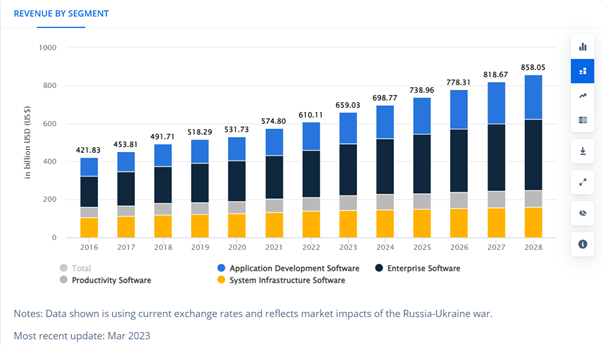
The future trends in software engineering are booming, with the projected valuation of the enterprise software market expected to reach $305.13 billion in 2025, and by 2027, it is predicted to be $347.27 billion. Many of the biggest trends and a few challenges will erupt in the software market between 2023 and 2025.
However, revenue will be segmented according to the software solutions companies use (as shown in the figure below).
This article covers some upcoming trends related to software development and programming for the year 2026, as well as practical advice for Developers, and IT Leaders.
Top Software Development & Programming Trends to Watch in 2026
The speed of technological advancement has accelerated over the years, and thus the Software Development industry has had to keep pace with that increase in speed. Companies that provide “smarter, faster, cheaper” Digital Solutions will dominate the market in 2026 and beyond.
The introduction of AI-driven development, Low Code Development, and Cloud Native Architectures are just one example of how the Software Development process is evolving into a new era of Intelligence, Automation, and Scalability.
AI-Driven Software Development: From Copilots to Agentic Workflows
As we move forward into 2026, artificial intelligence will no longer just be the assistant to a developer’s code autocomplete. AI will now take on a role as a collaborative team member, assisting developers throughout the entire Software Development Life Cycle (SDLC).
Key Applications:
- Automatic generation of boilerplate code (CRUD operations, DTOs, API clients).
- Generating unit tests, pull requests, and CI/CD checks.
- Analyze customer behaviour to personalize applications.
Why It Matters:
AI-based Tools reduce developer errors, speed up delivery, and ensure Quality Consistency throughout distributed and/or offshore development teams.
There are many AI-based tools, such as GitHub Copilot, ChatGPT-style Assistants, and Agentic AI Workflows, that will become essential components of modern SDLCs.
Implementation Tips:
- To use AI Technology in your Organisation, tie it back to Existing Design Systems, Program/Code Patterns, and security policies.
- Measure Performance Using DORA Metrics, Defect Rates, and Review Cycle Times.
- Adjust the AI Prompts for Optimal Results Based on Your Existing Codebase.
DevSecOps by Default: Security as Code
Security is no longer an afterthought. With rising supply chain attacks, DevSecOps ensures security is embedded from day one.
Key Practices:
- Use Automated Vulnerability Scanning, Policy-as-Code, and SBOMs (Software Bill of Materials).
- Sign Commits, Use Signed Artifacts, and Employ CI/CD Security Gates.
- Start to the Left with SAST / DAST / IAST and Lightweight Threat Modelling.
Why It Matters:
Including Security in the Development Process Minimises Risk, Protects Customers’ Data, and Helps to Comply with Regulatory Requirements Without Impeding Speed to Market.
Implementation Tips:
- Create a Bill of Materials as Part of Your Builds and Enforce Dependency Management Policies.
- Automate the Remediation of Documented CVEs.
- Train teams in secure coding practices and run security workshops.
Cloud-Native & Azure Development: Scalable, Intelligent Infrastructure
Cloud Native technology will help improve the way Development is done in the future. By using Microsoft Azure AI to deliver Data Insights and Data Analytics, it will be possible for Developers to make real-time updates to the Production Environment.
Benefits:
- Migrate Legacy Applications to Cloud Native Platforms
- Minimizing Real-Time Downtime when Processing
- Increased Collaboration Across Teams That Are Geographically Dispersed Through Version-Controlled Shared Developer Environments.
Implementation Tips:
- Implementing Internal Developer Platforms (IDPs) and Infrastructure as Code (IaC) Blueprints
- Standardizing the Approach to Observability (Traces, Logs, and Metrics) and Cost-Management Controls
- Automating the process of Deploying Code so that Error-Free and Timely Release can be accomplished.
Low-Code Development with Governance
Low-code apps can be developed and released faster than traditional coding methods while allowing non-developers to participate in the development process. Together, low-code with Governance will prevent companies from allowing “shadow IT” while also increasing the speed of innovation.
Applications:
- Rapid prototyping and internal workflow automation.
- Business teams can build apps using templates and drag-and-drop tools, with IT oversight.
Implementation Tips:
- Establish centers of enablement with templates and standards.
- Integrate low-code apps with enterprise identity, API gateways, and audit logs.
- Low-Code Development has its most significant advantages when used in strictly defined, narrow use cases (examples: dashboards, approval workflows, and internal utility tools).
Edge & Event-Driven Architectures
The rise of IoT, sensors, and real-time applications is driving edge computing and event-driven architectures.
Benefits:
- Significantly reduce the egress costs that are incurred by sending data to and from the cloud (e.g. loss of bandwidth, cost of scaling the cloud, reduced hardware and infrastructure costs).
- Increase operational resilience, even with intermittent connectivity.
- Encourage faster data processing that results in real-time insights.
Implementation Tips:
- When modelling a particular domain, explicitly define the Domain Events in accordance with a standardised event schema.
- Filter/Process Data at the Edge and enrich centrally.
- Ensure that mission-critical data is Idempotent and processed Exactly Once.
Tools: Kafka, Pulsar, Kinesis, serverless runtimes for event-driven workloads.
Progressive Web Apps (PWAs) & Cross-Platform UX
Users want a fast experience that works offline, and that does not require them to install anything. To help solve this need, PWAs and frameworks like React Native and Flutter allow businesses to create high-performance, cross-platform solutions for their customers.
Benefits:
- Enabling companies to reach a broader market via their solution rather than via traditional App stores.
- Enabling companies to provide almost identical performance and capabilities for their solutions regardless of the platform on which they are operating.
- The ability to better optimize SEO, Core Web Vitals, and Accessibility.
Implementation Tips:
- Use PWAs for content-based applications (e.g., news apps, eCommerce).
- Focus on developing a performance budget, offline capability, and push notifications.
- Establish a shared UI system and Design Tokens approach to create a consistent user experience..
.NET Core & the Java Renaissance
.NET Core Development
- NET Core Development is a great platform to build cross-platform, scalable applications in Cloud Native and Microservices Architecture.
- A plethora of Azure Services make it easy to build, secure, and perform at high levels with .NET Core Applications.
Java Renaissance
- With Java 21, Spring Boot 3, and GraalVM, Java is modern, cloud-native, and AI-ready.
- Performance improvements, AOT compilation, and container-friendly runtimes make it viable for serverless and edge computing.
- Supports integration with AI and ML libraries like LangChain4j and OpenAI Java SDK.
Implementation Tips:
- Use .NET Core for enterprise APIs, cloud apps, and microservices.
- Upgrade Java applications to modern frameworks and container-ready builds.
- Integrate AI models to extend enterprise apps into intelligent platforms.
Recommended: How To Implement Azure Key Vault In .NET Core?
Offshore & Distributed Development
Due to the scalability of Offshore Development, the cost-efficient nature of Offshore Development, and the expertise and skills associated with offshore development.
The combination of AI, DevSecOps, and Cloud-Native Development provides businesses with the ability to quickly develop and deploy high-quality and secure applications using distributed teams.
Best Practices:
- Implement hybrid onshore-offshore models for 24/7 productivity.
- Use advanced collaboration tools and standardized processes.
- Embed security and quality checks across time zones.
Recommended: Must Know Software Development Best Practices For Every Developer
Conclusion
Protect Your Software and Establish User Confidence Through Digitally Signed Applications. SignMyCode provides businesses with secure, Verified, Tamper-Free, and Trusted Code Signing Certificates in Compliance with Industry Standards for All Applications, Scripts, and Executable Files.
Trusted Code Signing Certificates
Prevent Code Tampering and Authenticate Code Integrity by Digitally Sign your Code with Trusted Code Signing Certificates.
Get Code Signing Certificate